





Église anglicane Saint André
Église anglicane Saint André
About this place
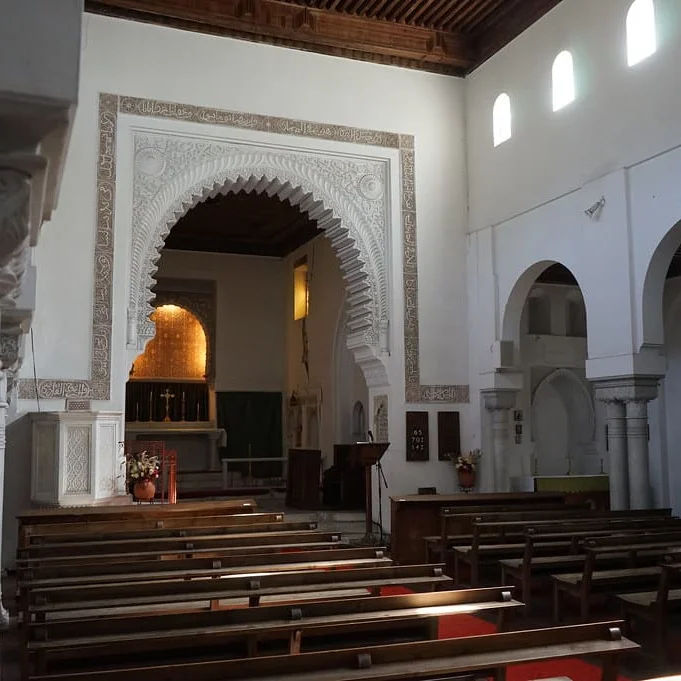
St. Andrew's Church is one of the most remarkable examples of religious and cultural fusion in Morocco, an Anglican church that embodies the unique spirit of Tangier's multicultural history. In 1880, Sultan Hassan I of Morocco donated land to the British community in Tangier for the construction of a small Anglican church. The original building soon proved too small for the growing congregation, and construction of the present church began in 1894, with consecration following in 1905. What makes St. Andrew's extraordinary is its architecture — rather than imposing European Gothic or neoclassical forms, the church was designed in a Moorish-Andalusian style, crafted with the help of Moroccan Fassi craftsmen using traditional techniques and materials. The bell tower is shaped like a minaret, the roof is decorated with green Fassi tiles, and the interior features carved wood, geometric patterns, and decorative elements that would be at home in a Moroccan mosque. Most remarkably, the Lord's Prayer is inscribed in Arabic calligraphy around the chancel arch — the only Anglican church in the world to feature such an inscription. The church's cemetery contains graves of notable figures including Emily Keene, the British humanitarian who introduced the cholera vaccine to Morocco and became Sherifa of Wazzan, and Thomas Kirby-Green, one of the participants in the Great Escape who was executed on recapture. Henri Matisse's 1913 painting "Landscape Viewed from a Window" depicts the church. Today, St. Andrew's is maintained by a Muslim caretaker, Yassine Khamlichi, symbolizing the centuries-old interfaith coexistence that defines Tangier.